
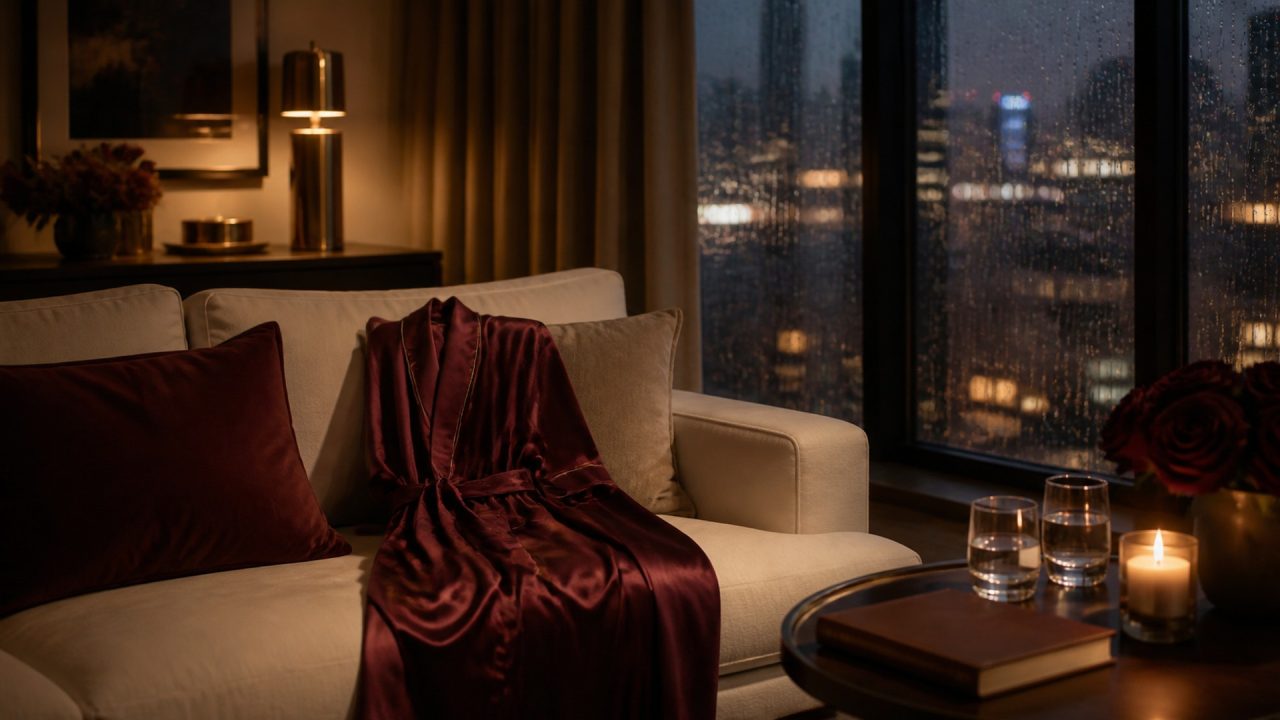
Date night at home ideas work best when the evening feels different before anything dramatic happens. Date night at home rarely fails because the house is too familiar. It fails because nothing tells the body that the evening has changed.
The same lamp stays bright. The phone remains within reach. There is a cup in the sink, a question from work still open in the mind, and a half-finished conversation waiting to become the rest of the night. Then we ask intimacy to appear on command, as if it has not noticed that the room still belongs to the day.
I prefer a quieter beginning. For me, a private evening starts with a threshold: a small, deliberate change in light, scent, texture, and attention. It is not a performance and it is not a project. It is simply a way of saying that we have arrived somewhere else together. These are my date night at home ideas when I want the evening to feel slower, warmer, and less like an ordinary Tuesday wearing a nicer shirt.
I do not need a perfect apartment, an elaborate menu, or a plan with twelve steps. I need a room that gives us permission to stop rushing. From there, everything becomes easier to notice.
Begin by changing the room before you change the plan
A romantic date night at home begins before either of us sits down. I start with what the room is saying. Bright overhead light says finish your tasks. A crowded table says there is more to manage. A television already talking says that silence will have to compete for its place.
I turn off the light that makes everything look like it is waiting for a meeting. I leave one smaller lamp on, or light a candle where it can be watched without demanding attention. I clear the surface nearest to us: not with the solemnity of spring cleaning, but enough that a glass, a book, or a hand has somewhere to rest. I fold the throw at the end of the sofa. I put away the delivery box that has been accusing me since Monday.
The point is not decoration. It is a signal. When I remove the objects that belong to errands and obligation, I make space for an evening that can move at its own pace. A room feels romantic not because it is crowded with gestures, but because its light, its surfaces, and its silences ask less of us.
That is the first thing I would remember if I were looking for at-home date night activities: choose one change that separates tonight from routine. Dim the room. Set a cloth napkin beside a simple meal. Put a record on before the doorbell rings. Let the threshold be visible, even if only the two of you know what it means.
Choose one intention, not a whole evening to perform
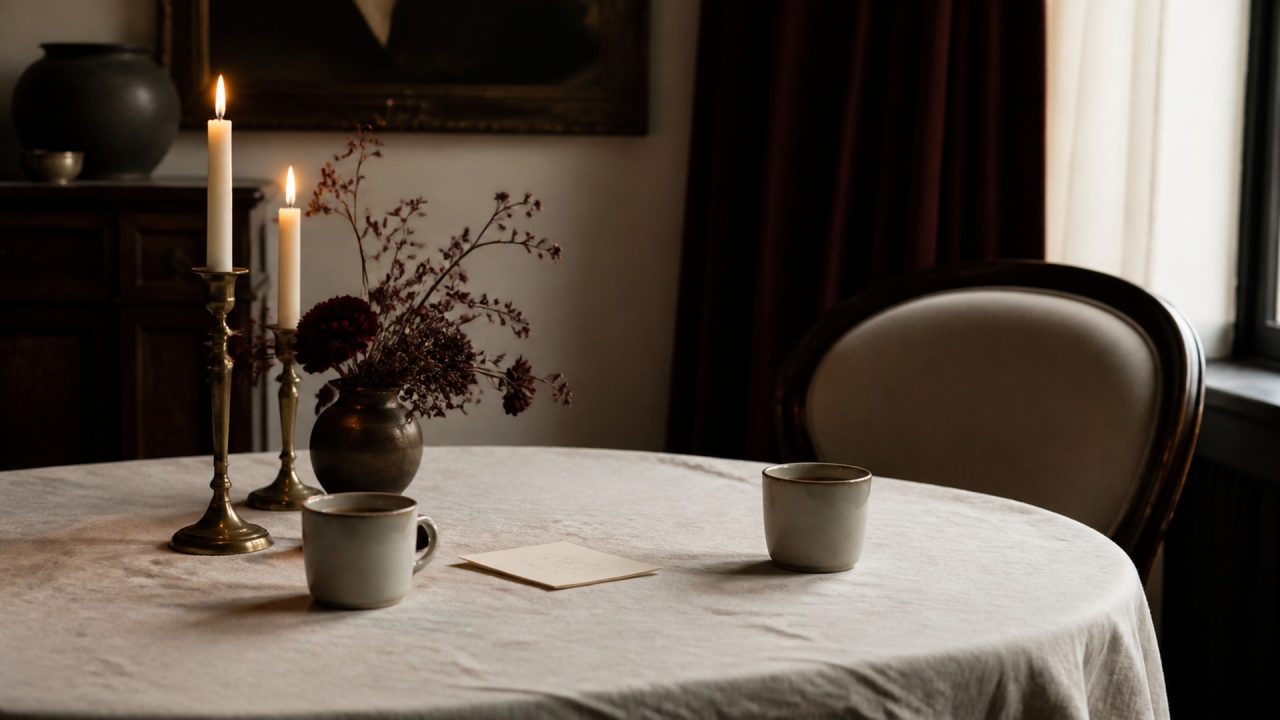
There is a small pressure around date night that I dislike: the feeling that a good evening must be clever, romantic, productive, memorable, and somehow effortless at the same time. That is too many jobs for one night.
Before I decide what to make or play or pour, I choose one intention. Perhaps I want closeness after a difficult week. Perhaps I want playfulness. Perhaps I want a night that feels quietly sensual, with no expectation beyond that. Perhaps I simply want to be in the same room without either of us pretending to be less tired than we are.
One intention gives the evening shape. If the intention is rest, I do not fill the table with conversation cards and a new recipe that needs watching. If it is curiosity, I might ask one question we have not made time for lately. If it is romance, I pay attention to pace: I leave a little empty space between the meal and whatever comes next. Anticipation needs room.
I find this gentler than trying to manufacture a mood. We do not need to prove that we are having a special night. We only need to agree, quietly, on what would make it feel like ours.
Let scent arrive as an invitation
A soft scent can make a room feel quietly different before the evening has properly begun. One candle, a little room spray in the hallway, or a diffuser set far enough away that it does not become the loudest presence at the table is usually enough.
I prefer notes that stay close: tea, cedar, paper, a little amber, clean linen after a warm shower. The scent should not announce a theme. It should make the room feel as though it has a private temperature. If someone steps in from rain or traffic or a long day, the change should be felt before it is named.
Too much fragrance has the opposite effect. It turns atmosphere into a showroom and makes it difficult to relax into the ordinary pleasures already there. When in doubt, I use less. A date night at home does not become more intimate because every sense is asked to work overtime.
If either of you is sensitive to fragrance, leave it out entirely. Open a window for a minute instead. Brew tea. Put clean sheets on the bed. Comfort is more seductive than a rule followed for its own sake.
Dress for the mood, not for an audience

I like to change clothes before a private evening, even if I have nowhere to go. It is not about looking finished. It is about letting my body understand that the workday has ended.
Sometimes that means a soft shirt, bare feet, and a piece of jewelry I had not worn all day. Sometimes it means a robe over clean skin, or a silk blouse that feels different once the phone is no longer in my hand. Texture has a way of slowing me down. A sleeve brushed by candlelight, a cool glass held between warm palms, a blanket pulled over two knees: these details are not decoration. They are attention made visible.
I would never make the evening depend on whether I look a certain way. The most intimate version of getting dressed is choosing what lets me feel present rather than observed. Let the clothes be a private signal, not a costume someone has to earn.
Put the phone somewhere that changes the conversation
There are few things less romantic than placing a phone face down between two people and calling it unavailable. The small black rectangle still holds the room hostage; it is simply resting.
For the first part of the evening, try leaving both phones in another room. Not forever, and not as a dramatic purity ritual: simply remove the reflex of checking them when a conversation reaches a quiet place. Silence can be tender when it is allowed to stay.
Without the phone nearby, I notice more. I notice the pause after a question. I notice whether the music has ended. I notice the moment when someone reaches for a glass and leaves their hand close to mine for an extra second. The evening does not need constant stimulation to feel alive. Often, it needs fewer interruptions.
Add touch slowly, with comfort first
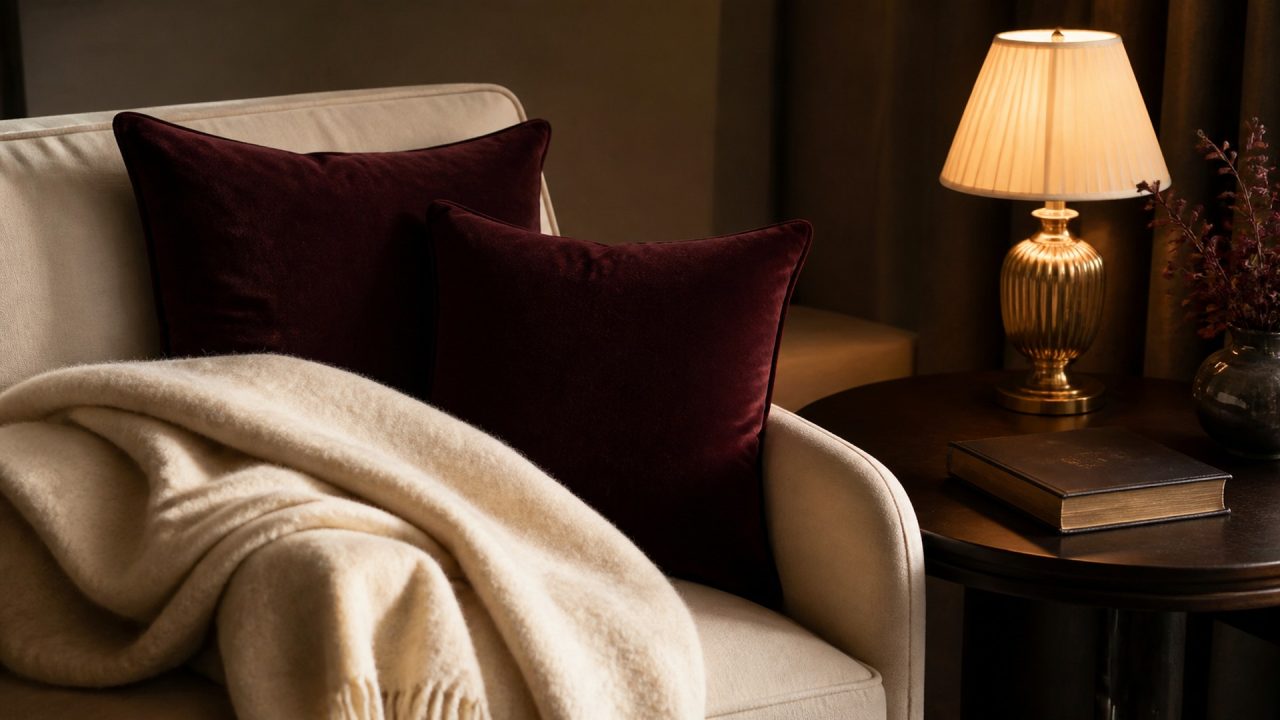
Touch should never be treated as the required final act of a romantic evening. I think it becomes more meaningful when it has permission to remain small.
A hand at the back of the neck while passing in the kitchen. A shoulder rubbed after dinner. Bare feet touching beneath a blanket. These can be enough. When I want more closeness, I begin by asking rather than assuming: Would that feel good? Do you want to sit closer? Should I stay here?
That question does not interrupt the mood. It protects it. Desire has more room to breathe when no one has to guess whether they are expected to continue. Nothing is lost by going slowly.
I like touch best when it is an extension of attention, not a shortcut to an outcome. The evening can become sensual without becoming scripted. It can also remain a quiet dinner and a long conversation. Both are real forms of intimacy.
Keep one object nearby, but do not make it the point
For a night at home, I keep only a few things within reach: water, something simple to drink, a book or record, a clean towel if the evening might end in a shower, perhaps a small tray so nothing feels precarious. One beautiful object can anchor a room. Too many objects make it feel staged.
The rule I return to is simple: an object should continue the atmosphere, not replace it. A candle can soften a corner. A robe can mark the shift from public to private. A book can give the conversation somewhere to rest. But none of them can create closeness in place of care, consent, or honest attention.
Give the conversation a quieter shape
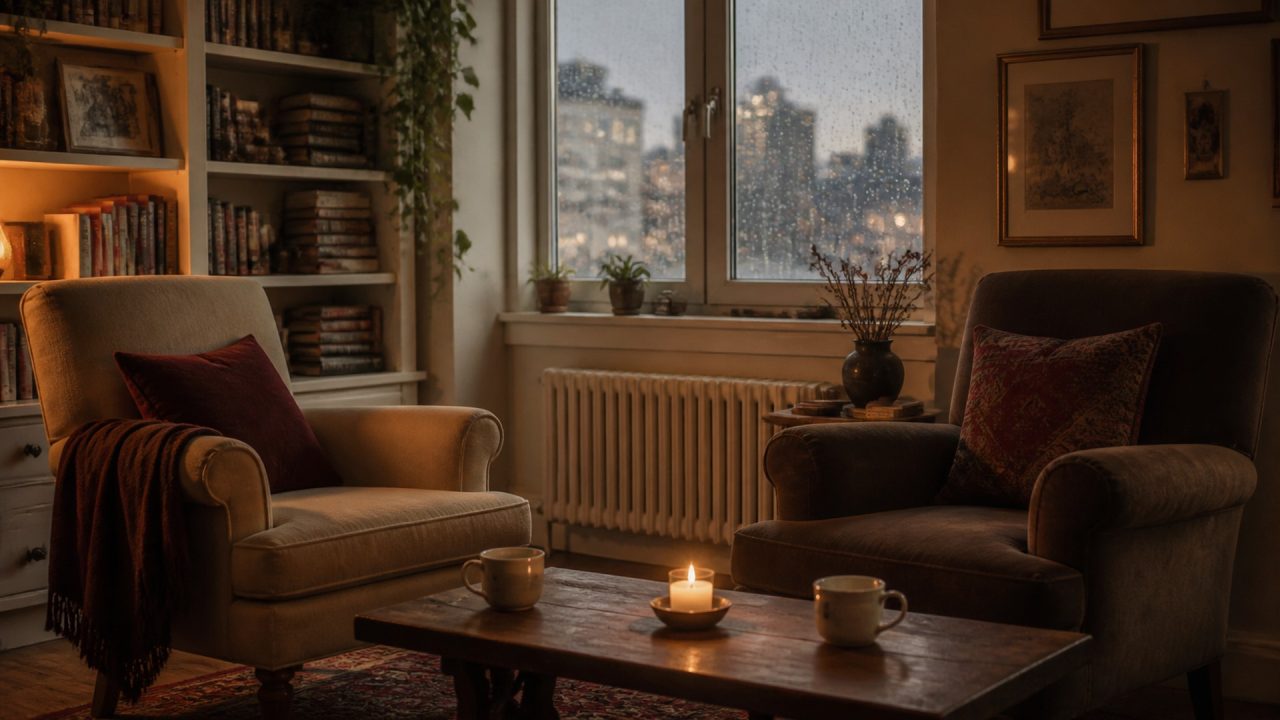
We often speak all day without really arriving in a conversation. We exchange logistics, opinions, fragments of news, small complaints that disappear before dinner. On a private evening, I like one question that cannot be answered while standing at the counter.
I might ask: What felt unexpectedly good this week? What have you missed lately that is not an object? What would make next month feel less hurried? The question does not need to be profound. It only needs to invite a different kind of listening.
Then I let the conversation wander. I do not turn it into a relationship audit or a game with points. Some nights the most intimate thing is admitting that the week has been too loud. Some nights it is laughing at something trivial until the room feels lighter. The purpose is not to extract a revelation. It is to make enough space that one can appear if it wants to.
A simple at-home date night ritual checklist
When the day has been long, I use this small sequence instead of trying to invent an evening from nothing:
- Choose one intention: rest, connection, playfulness, or quiet sensuality.
- Clear one visible surface and turn off the harshest light.
- Add one gentle sensory cue: low music, a candle, tea, or fresh air.
- Change into something comfortable that does not belong to the day.
- Put phones away for the first hour.
- Prepare something simple to share; do not make cooking the main event unless you genuinely enjoy it.
- Ask one unrushed question and let the answer take its time.
- Let touch begin with consent and comfort, never expectation.
- Keep the room simple enough that silence can stay.
- End before the evening becomes another task to complete.
The checklist is not a test. Skip whatever does not belong to your night. A ritual should make you feel less managed, not more.
Let the evening have an unfinished ending

I do not like to decide in advance what a private evening must become. Sometimes it ends with a book open between us, a candle nearly gone, and the soft relief of not needing to go anywhere else. Sometimes it becomes more intimate. Sometimes it ends early because sleep is the most honest thing either of us can offer.
All of those endings can be beautiful. The change is not in how impressive the night appears from outside. It is in whether the room gave us a chance to hear ourselves again.
That is what I return to when I think about date night at home: not another activity to complete, but a threshold to cross together. Lower the light. Put the day outside the door for a while. Let the evening stay a little unfinished. Desire does not always need an ending. Sometimes it only needs a room quiet enough to begin. Explore more private rituals for an evening at home.