This adult bedtime story begins after hours, in a gallery where rain, attention, and choice make room for a quieter kind of closeness. I was turning off the last lamp when I heard the gallery door close behind me.
Not the careless clatter of someone arriving late. A deliberate sound: the hinge settling, the rain held briefly outside, a breath taken before a name.
“Sophia?”
I knew his voice before I turned. Adrian stood just inside the empty room with his umbrella folded at his side, his dark coat beaded with rain. He had been one of the architects at the opening two weeks earlier—the one who had looked at the paintings as if he had come to listen, not be seen listening. I had not expected him to return. I had certainly not expected the small, inconvenient lift in my chest when he did.
“We are closed,” I said, though the key was still warm in my hand.
“I know.” He raised a flat paper portfolio. “You left this in the studio yesterday.”
It was mine, unmistakably: the black folder with its softened corners, containing the notes for a private commission I had not yet decided to accept. He had no reason to bring it himself. He had no reason to stand there looking as though the rain had asked something of him and he had not known how to refuse.
“You could have left it with reception.”
“I could have.” His mouth shifted, almost a smile. “But it felt careless.”
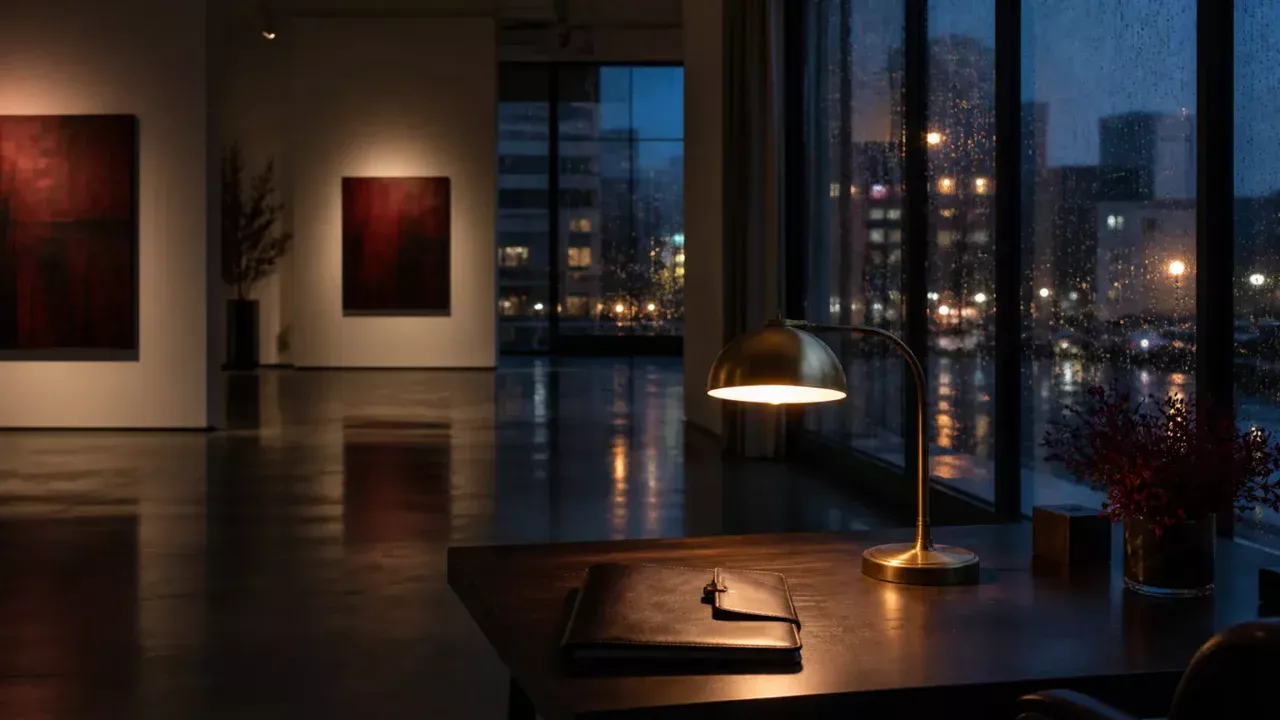
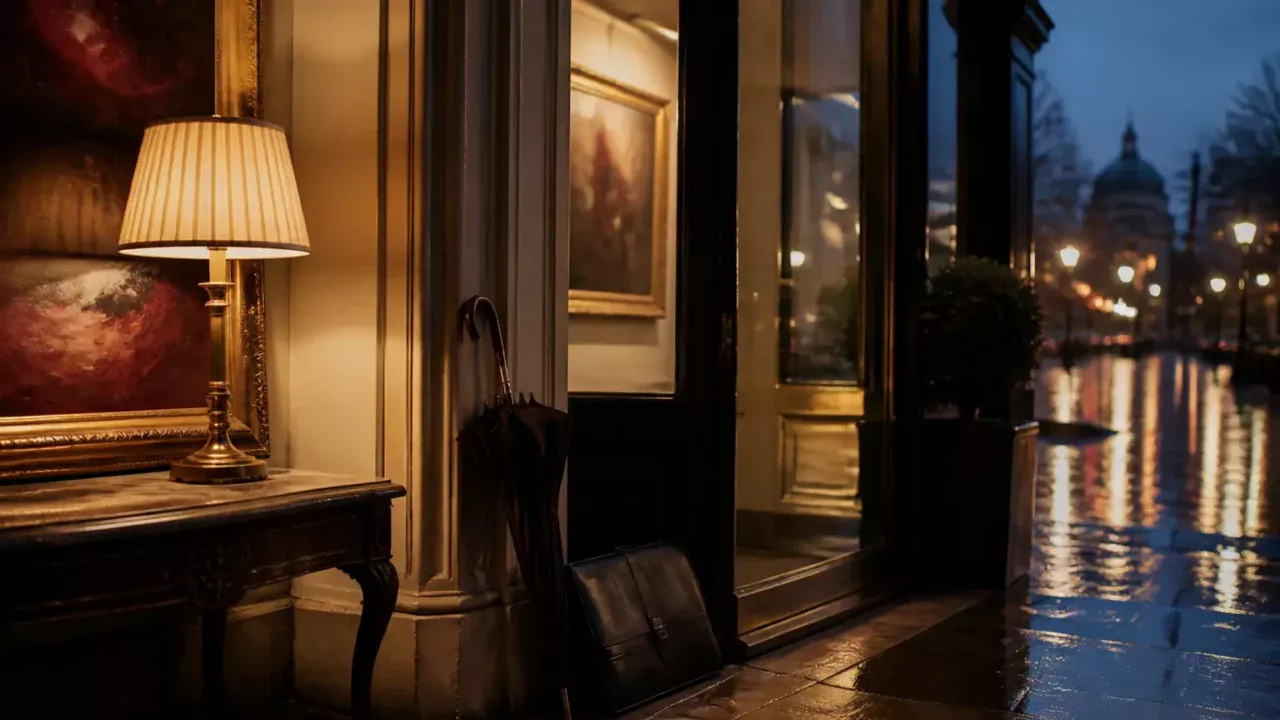
Outside, the city shone in the blue hour it reserves for people who have missed their sensible trains home. The gallery had changed after closing. In daylight it was all white walls and measured distances; now the brass lamp at my desk made a small island of warmth against the windows.
The room had already become a different room
I took the folder, but did not move toward the door. Adrian noticed. He noticed too much, I thought, and then corrected myself: perhaps he simply waited long enough to see what was offered.
“Would you like tea?” I asked.
He looked at the rain, then back at me. “Only if you mean it.”
“I do.”
In the little kitchen behind the exhibition space, I filled the kettle and felt absurdly aware of ordinary things: the soft click of the switch, the cuff of my silk blouse against my wrist, the quiet behind us. Adrian leaned against the doorway without crossing it. There was an ease in that restraint. He did not make the room smaller by entering it.
“Did you decide about the commission?” he asked, nodding toward the portfolio.
“Not yet.”
“Why not?”
I could have said timing. I could have said the fee was wrong, or the scope too vague. Those were the respectable answers. Instead I watched the first thread of steam rise from the kettle.
“They want the space to feel expensive,” I said. “They do not seem interested in whether anyone wants to remain in it.”
Adrian was quiet for a moment. “That is a lonely brief.”
It was not the answer I expected. Most people praised work like that for being polished. He understood, without needing the whole explanation, that polish and welcome were not the same thing.
“You designed the stairwell in the east wing,” I said. “The one people keep standing in even when they have nowhere to go.”
His eyes met mine. “I hoped it would make them pause.”
“It does.”
The kettle clicked off. Neither of us moved immediately.
He gave me an honest way to say no
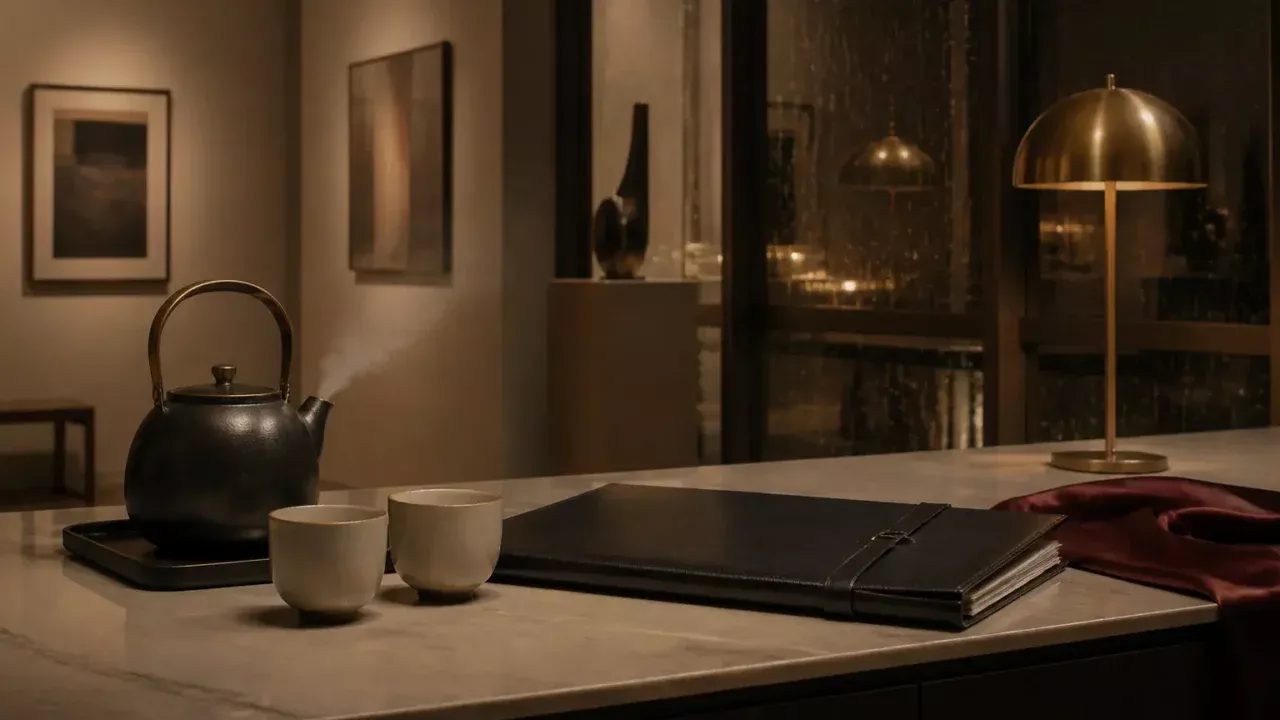
We carried our tea back to the desk. Rain blurred the towers across the avenue until the city looked hand-painted, its lights loosened into gold. Adrian set his cup down carefully beside the closed portfolio.
“I came back for another reason,” he said.
There it was. Not a performance of surprise, but the quiet turn I had felt waiting since the door closed.
“All right.”
“I am leaving the firm.” He said it without flourish. “Tomorrow, I am telling them.”
I looked at him. “That sounds like a reason to be somewhere dry with a friend, not in a gallery after hours.”
“Probably.” He gave a brief, unguarded laugh. “But you were the first person I thought of who might understand why I am afraid of a thing I want.”
Something in me softened, then held its shape. I knew that fear. I had spent years calling it discernment, which was sometimes true and sometimes a more elegant name for retreat.
“Do you want me to tell you it is a good idea?” I asked.
“No.” He looked down at his hands. “I want you to tell me if I am asking too much by being here.”
The question made the evening clearer. I could choose the door, the distance, the ending. Nothing about the rain or his expression had taken that from me.
“You are not,” I said. “But I do not want to be brave on your behalf.”
“I would not ask you to.”
“Good.” I moved the portfolio aside. “Then tell me what you want to build when no one is asking for a statement staircase.”
His answer came slowly at first. Small libraries. A rehearsal studio with windows low enough for children to see the street. A room in a hospital where families could sit without being watched. Places that did not confuse grandeur with care.
I listened. The more specific he became, the less afraid he sounded. By the time he stopped, the rain had gentled against the glass.
“That is the commission you should take,” he said, touching the edge of my folder but not opening it. “The one that leaves room for someone to stay.”
“You have not read it.”
“No.” His gaze lifted to mine. “I have only watched you make rooms.”
When I reached for him, it was not an answer to anything
I could have let the moment become a beautiful mistake—one of those polished scenes that look complete from a distance and feel empty the next morning. I did not want that. I wanted the truth of the room: two adults, each with a decision waiting beyond the windows, each allowed to leave without making the other smaller.
“I should lock up,” I said.
“You should.”
He did not stand. He did not turn the silence into a request.
I set my hand on the desk between us, palm open. It was a small gesture, but it belonged entirely to me. Adrian looked at it, then at my face.
“May I?” he asked.
“Yes.”
His hand met mine with the gentleness of someone placing a fragile thing back where it belongs. I felt the warmth of his fingers, the steady pressure, and then his thumb moving once over my knuckle. No urgency. No claim.
I stepped closer because I wanted to see whether the calm in him would remain when the distance did not. It did. When he kissed me, he paused first, close enough for me to change my mind. I answered by lifting my chin, by resting my other hand at the line of his collar, by staying.
The kiss was not dramatic. It was better than dramatic: rain-muted, deliberate, warm enough to make the room seem briefly separate from the city. When we drew apart, I could still hear the kettle cooling in the kitchen.
“Tomorrow will be difficult,” I said.
“Yes.”
“And I may still refuse the commission.”
“You may.”
I smiled then, because he had understood the only promise I wanted. Not that he would make my choice easier. Not that I would rescue his. Only that neither of us had to become less honest to be close.
At the door, he opened his umbrella and looked back once. “Will the lamp be on next week?”
I considered the question. Then I let the key turn in my hand.
“If I decide it should be,” I said.
He smiled—not as if he had won something, but as if he trusted the answer. I watched him cross the wet pavement until the rain folded him into the evening. Then I returned to the gallery and left the brass lamp on for a little while longer.